

The biggest lie in AI commerce is that the chatbot is the product.
In the rush to "AI-enable" the retail experience, we have committed a fundamental error. We have mistaken the interface for intelligence. A chatbot without a proprietary Knowledge Graph is merely a linguistic mask for data fragmentation, a polished facade hiding a hollow interior.
The Interface Fallacy
The current retail landscape is saturated with "experience-level AI" tools that prioritize the novelty of natural language over the precision of domain logic. When a brand treats the chat bubble as the solution, they are paying for Hallucination-as-a-Service.
The friction arises when these surface-level tools fail to convert. A chatbot that can mimic human prose but cannot distinguish between product variants within a specific brand's semantic ontology is a liability, not an asset. It creates a conversational loop that erodes consumer trust because it fails to address the structural complexities of product attributes, compatibility, and inventory. To solve this, we must look beneath the surface.
The Structural Diagnosis: The Invisible 90%
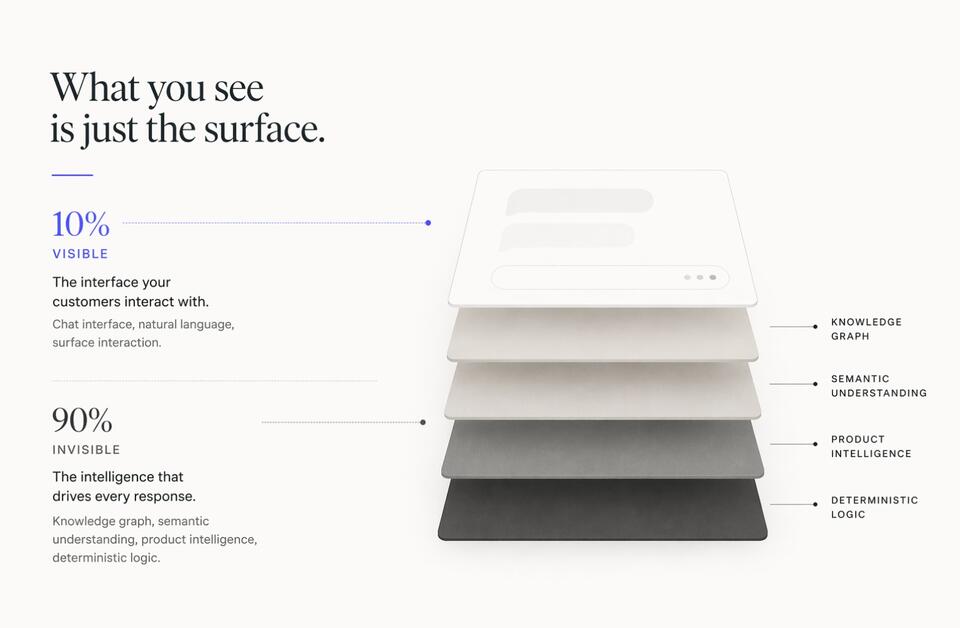
To understand the failure of generic conversational AI, we must apply Hemingway's Iceberg Theory to system architecture. The chatbot is merely the visible 10% of the solution. The remaining 90%, the part that provides the "buoyancy" for the experience, is composed of invisible infrastructure.
What Brands See (The 10%):
- The Conversational Interface: The text box, the "typing..." indicator, and the natural language fluency.
- Surface-Level Engagement: Probabilistic "guesses" at retail intent based on statistical word association.
- The Linguistic Mask: A commodity layer that sounds human but lacks domain-specific authority.
What Actually Drives Performance (The 90%):
- The Knowledge Graph: A proprietary semantic map connecting product attributes, brand identity, and shopper behavior into a single navigable truth.
- Semantic Ontologies: The structured framework that understands why products relate to each other beyond mere proximity or keyword matching.
- Deterministic Logic: Moving beyond LLM "vibes" to hard-coded brand rules and prediction models.
Most competitive solutions operate almost entirely within the 10%. Without a foundational discovery layer, an AI lacks the structural intelligence required to actually sell.
Moving the Center of Gravity
The evolution of retail AI requires moving the center of gravity away from the interface and toward the Intelligence Layer. This architecture ensures that the "moat" is not found in how well the AI speaks, but in what the AI knows. This shift is defined by three core pillars:
- The Knowledge Graph: This is an IP-defensible asset. It transforms fragmented SKUs into a relational web of product intelligence.
- The Discovery Layer: This infrastructure allows for Generative Experience Optimization (GEO), ensuring product discovery is driven by intent and context rather than static, brittle keywords.
- Agent-to-Agent (A2A) Readiness: Designing systems where retail intelligence can communicate directly with a consumer's personal AI agent, eventually bypassing the manual chat interface entirely.
By prioritizing this layer, the system remains robust even as the interface evolves, moving from text to voice, or from human-to-bot to agent-to-agent.

Strategic Implications: Infrastructure Over Features
For retail executives, the strategic pivot is clear: stop buying chatbots and start building intelligence infrastructure.
When you prioritize the Intelligent Layer over the interface, you move from a "feature-based" implementation to a "foundational" one. The goal is not to have an AI that can talk about your products. It is to have an AI that understands the architecture of your catalog well enough to navigate it.
The era of the "chat bubble" as a standalone product is over. In the next decade of commerce, the winners won't be the brands with the most talkative bots. They will be the brands with the deepest roots.
After all, in a world where everyone can talk, the only thing that matters is who actually knows what they're talking about.
Hope you enjoyed the reading.
Álvaro T.
Sources
- Hemingway, E. Death in the Afternoon (1932). Origin of the Iceberg Theory / Theory of Omission.
- Universal Commerce Protocol (UCP). Google & Shopify (2026). Standardizing Agent-to-Agent (A2A) commerce interactions.
- Search Engine Land. "Generative Engine Optimization (GEO): How to win AI mentions" (Feb 2026).
- McKinsey & Co. "The State of AI: Global Survey 2025." On the shift toward systemic AI workflows.
- Emerald Publishing. "The role of knowledge graphs in chatbots." Research on semantic links and response quality.